Wednesday, November 13, 2013

In last week’s "Did You Know" article, I wrote about a strange illness that hit migrants who were moving to the Midwest in the early 19th century. The fatality rate was so high that sometimes half the people in a frontier settlement might die of milk sickness. The disease seemed to originate with animals, which died by the thousands, as well. No one knew the cause, only that it appeared to hit people after they consumed meat or milk from infected animals. When farmers cleared the riverbanks and grazed cattle on tended fields, the spread of the illness abated.

The cause remained unknown until Dr. Anna Pierce Hobbs (Bixby) began practicing in Rock Creek, Illinois. Some documents state that Dr. Anna studied nursing, midwifery, and dental extraction in Philadelphia—the only medical courses offered to women during that time.

Apparently she dealt well with the frontier ailments the settlers faced until an epidemic of milk sickness ripped through the settlement. Her mother and sister-in-law died, and her father became seriously ill with the ailment.

Dr. Anna was driven to find a reason for the disease. She determined that it was seasonal and began in summer and continued until the first frost. She also noted that it was more prominent in cattle than in other animals, suggesting the cause might be a plant eaten by the cattle, which are herbivorous and not careful in their selection of plants they eat.

Legend says that while Dr. Anna followed the cattle in search of the cause, she happened upon a Shawnee Indian woman who told her that white snakeroot plant caused milk sickness. When the animals ingested the plant, it poisoned their milk.

Dr. Anna then tested her hypothesis by feeding the plant to a calf, demonstrating its poisonous properties. The doctor, along with others in her community, began a campaign to eradicate the plant from the area. Although Dr. Anna was correct in her analysis, she received no official recognition for her discovery.

Not until 1928 did researchers at the U.S. Department of Agriculture, led by Dr. James Couch, isolate the cause of disease from white snakeroot. It was a highly complex alcohol they named tremetol. At that point, white snakeroot was officially named the cause of milk sickness. As the knowledge spread throughout the medical and agricultural communities, fencing laws and supervised milk production largely solved the milk sickness problem.

Human milk sickness is uncommon in the United States today, although the poison is not inactivated by pasteurization. Current practices of animal husbandry control the pastures and feed of cattle, mostly eliminating the possibility of tremetol poisoning in the milk supply.

As for Dr. Anna Pierce Hobbs Bixby, she is the subject of some controversy. She was the subject of plays, poems, and a ballad. Some claim she was simply an illiterate midwife, not a well-read medical doctor.  But she served as Rock Creek's only physician until her death in 1873 of a heart attack at age sixty-one.

Tuesday, November 12, 2013

Robert Louis Stevenson said, “There is but one art, to omit.” He obviously appreciated the power of polish. I call polishing powerful, because it has the ability to transform a rough draft into
something remarkable—something salable. After I complete a rough draft I go over it quite a few times, checking for problems, large and small. Here are 40 power-polishers from my personal list. 

  1. Did I sprinkle in backstory like a fine spice or did I dump the whole jar in at the beginning? 
  2. Do my characters have plenty of quirks and ticks like real people? 
  3. If I repeated words are they beautifully rhythmic or just annoyingly repetitious? 
  4. Is it clear which characters are talking, or will readers need to stop to figure it out? 
  5. If I altered anything midway—a character’s hair color, the season of the year, etc.—did I make those changes all the way through the manuscript? 
  6. Did I check each “was” and “were” as well as other potentially scrawny verbs? Do some of them need to be removed from the herd? 
  7. Is the word “that” used so much that readers will become so weary of that that they’ll want to use my novel for kindling? 
  8. Have I included literary devices such as sensory details, foreshadowing, irony, metaphors, and similes to give my story depth and delight? 
  9. Did I dip so randomly and deeply into the barrel of limp and colorless adjectives and adverbs that my prose came out hopelessly anemic?
  10. Are the elements of action, description, and dialogue balanced in my story? 
  11. Is my point of view consistent, or will I confuse readers by head-hopping? 
  12. Is the setting in each scene well-defined? 
  13. Are my characters unforgettable and believable, or are they one-dimensional and uninspiring because I haven’t spent enough time getting to know them? 
  14. Are my heroine and hero relatable and likable? Do they have enough noble and endearing qualities—along with their flaws—to make readers want to cheer them on? 
  15. Will readers know the year, the season, and the time of day easily, or are these story elements too vague? 
  16. Does my timeline have inconsistencies? 
  17. Did I vary the length of sentences in my paragraphs so they’re eye-appealing and easy to read? Are my paragraphs so long they’re like a wall of words in need of mental climbing gear? 
  18. How is my pacing? Is there a good rhythm to my storytelling? Are there passages I need to slow down or speed up for effect?
  19. Do I have too many summary paragraphs? Do some segments need to be revised so I’m showing and not telling? 
  20. Does my work have the fine brushstrokes of subtext dialogue?  
  21. If I’ve written in first person does it look like there was an “I” explosion all over the manuscript?
  22. If the professions and hobbies of the main characters are important to the story will the readers get a good look into this part of their lives? Was this material presented in a way that is organic to the story, and did I check the information for accuracy? 
  23. Is my dialogue realistic and interesting or mind-numbingly boring? 
  24. Do my characters have occasional and natural interruptions in their speech without being confusing?
  25. Have I taken out unnecessary words, such as some, began to, just, rather, and all at once?
  26. Does every scene have some element of suspense or conflict or intrigue? 
  27. Is each and every scene important to the overall plot, or have I padded the novel to up my word count? 
  28. Are some of my chapters too long?
  29. Do all my chapters end with cliffhangers?
  30. When my character presents a potent line of dialogue, do I use it later to make an arc that is memorable and effective? 
  31. Do I have a sagging middle that’s in need of a few tummy tucks of story tension? 
  32. Did I succumb to the temptations of authorial intrusion? 
  33. Do my characters make gestures that reflect their personalities, and are those gestures fresh and unique? Or are my characters engaged in too much shrugging, sighing, lip chewing, nodding, brow furrowing, arm crossing, throat clearing and head shaking?
  34. If I’ve added humor to my novel, does it fit the characters, and does it flow with the rest of the work? 
  35. Do the elements of faith happen naturally in the story, or did I toss in some prayer and Scripture to make it sound Christian? 
  36. Are the themes in my story memorable and effective? 
  37. Are the character’s thoughts interesting and necessary, or are they merely repeats of what the character is saying? 
  38. Do I have an overall story arc that is clear and memorable? 
  39. Did I create a satisfying ending, or is it too predictable and rushed because I’m tired of the story? 
  40. Have I read the work out loud to catch the errors that might be more obvious when heard rather than seen? 

I hope this mini version of my checklist is helpful in all your novel-polishing endeavors.

Anita Higman is a CBA best-selling and award-winning author. Among her many accolades, Higman has won the Inspirational Reader’s Choice award twice. She has written or co-authored more than 30 books, including fiction and non-fiction for adults and children, as well as plays. Higman has also been recognized for her contributions to literacy and has raised thousands of dollars with her book I Can Be Anything while serving on the board of directors of Literacy Advance of Houston.

Even though she’s written in many genres, Higman does have her favorite. “I love inspirational romance. There’s just nothing else like it for writing and reading. It naturally makes you want to curl up on an overstuffed couch and read the day away.” Her latest release is A Marriage in Middlebury

She loves good movies, exotic teas and brunch with her friends. Higman and her husband live in Houston, TX.


To keep up with Anita Higman, visit anitahigman.com, become a fan on Facebook (Author Anita Higman) or follow her on Twitter (@anitahigman).

Monday, November 11, 2013

About the Book

"Got an IMPOSSIBLE situation? The anxiety it brings can wake you in the middle of a needed night’s sleep and then stalk you in the middle of broad daylight. It can sneak up on you and cast a cloak of fear and concern over your shoulders that you can’t seem to shake no matter how hard you try. It can take you down. Squash all hope. Stop you in your tracks.

IMPOSSIBLE. IMPENETRABLE. UNCHANGEABLE. Maybe so . . . until God gets involved. No matter the details of your circumstance, His raw power potential and immeasurable ability refuse to cower in the face of any challenge. Nothing is impossible with God. Nothing. Not even that thing. This is the uplifting, well-reasoned answer from New York Times best-selling author Priscilla Shirer—not a denial of life’s adversities and troubles, but a biblical reminder that God is always up to great things, even when His great things are greater then instant remedies and visible change. He is a God who cares . . . and a God who CAN. Believe it. Experience it. God Is Able."

About the Author

"Priscilla Shirer is a Bible teacher and conference speaker with a Master’s degree in Biblical Studies from Dallas Theological Seminary. Also a popular author, her books include the New York Times best seller The Resolution for Women, One in a Million, and Life Interrupted. Priscilla is married to Jerry with whom she founded Going Beyond Ministries. They have three sons and live in Dallas, Texas."

From the Author


Want More?
  • You can find links to purchase the book HERE.
  • Stop by on Friday to complete a puzzle featuring the cover for a chance to win a copy of the book!

Sunday, November 10, 2013

Good morning, BB fans! Thanks to everyone who participated in our "puzzling" Friday giveaway! Keep all those facebook and Twitter notifications, coming!

This week's winner is: 

Lisa Nelson (storyreader617(at)yahoo(dot)com ) - Bleeding Heart by Amber Stokes.

Congratulations, Lisa! Thank you all so much for stopping by The Borrowed Book.
Max’ism – Now That’s Talent
Matthew 25:14-30


I’ve always thought Max was a smart dog, but he really impressed me one day when my husband pulled out the treadmill do his running.

Determined to get in shape for a ski trip we are planning over spring break, my husband has been running faithfully for about three weeks. Each time he turns on the treadmill, Max sits next to him, watching the belt speed by. Worried that he might try and grab the belt with his mouth, or get his paw stuck, I usually encourage Max to move away. But today, I wasn’t paying a whole lot of attention to him…until my husband called my name.

“Come see what your dog is doing,” he huffed.

So I went into the living room to watch. Max took his squeaky, carefully set it on the front of the treadmill, and waited patiently until the vibration of my husband’s pounding feet knocked it onto the belt. The squeaky then shot off the back, sailing into the air a good foot before hitting the ground. The moment the squeaky fell onto the belt, Max dashed around to the back of the treadmill and tried to catch the squeaky before it fell to the floor. Over and over he pulled the same trick, each time coming just a little closer to catching the toy. My husband got to laughing so hard he had to stop running.

“Now that’s talent,” he said.

“No kidding. I need to write a Max’ism about it.”

Basically, I thought it was such a neat trick I wanted to tell people about it. I didn’t want to hide Max’s little “talent.”

Which got me to thinking. God has given each of us a talent—something He wants us to use for His glory or the furtherance of His kingdom. What are we doing with the gifts He’s given us? Are we showing off our talent—using it for Him? Or are we hiding our talent, content to keep it buried where it’s of no use to us or the One who bestowed it?

If I’m serious about serving the Lord, I going to have to use everything He’s given me, even if it means digging up “an old talent.”

Matthew 25:14-30
The Parable of the Bags of Gold

14 “Again, it will be like a man going on a journey, who called his servants and entrusted his wealth to them. 15 To one he gave five bags of gold, to another two bags, and to another one bag, each according to his ability. Then he went on his journey. 16 The man who had received five bags of gold went at once and put his money to work and gained five bags more. 17 So also, the one with two bags of gold gained two more. 18 But the man who had received one bag went off, dug a hole in the ground and hid his master’s money.
19 “After a long time the master of those servants returned and settled accounts with them. 20 The man who had received five bags of gold brought the other five. ‘Master,’ he said, ‘you entrusted me with five bags of gold. See, I have gained five more.’
21 “His master replied, ‘Well done, good and faithful servant! You have been faithful with a few things; I will put you in charge of many things. Come and share your master’s happiness!’
22 “The man with two bags of gold also came. ‘Master,’ he said, ‘you entrusted me with two bags of gold; see, I have gained two more.’
23 “His master replied, ‘Well done, good and faithful servant! You have been faithful with a few things; I will put you in charge of many things. Come and share your master’s happiness!’
24 “Then the man who had received one bag of gold came. ‘Master,’ he said, ‘I knew that you are a hard man, harvesting where you have not sown and gathering where you have not scattered seed. 25 So I was afraid and went out and hid your gold in the ground. See, here is what belongs to you.’
26 “His master replied, ‘You wicked, lazy servant! So you knew that I harvest where I have not sown and gather where I have not scattered seed? 27 Well then, you should have put my money on deposit with the bankers, so that when I returned I would have received it back with interest.
28 “‘So take the bag of gold from him and give it to the one who has ten bags. 29 For whoever has will be given more, and they will have an abundance. Whoever does not have, even what they have will be taken from them. 30 And throw that worthless servant outside, into the darkness, where there will be weeping and gnashing of teeth.’

Friday, November 8, 2013

It's Fun Friday at The Borrowed Book! This week's giveaway is Kindle only.

To enter:

Leave the time it took you to complete the puzzles in the comments section as well as your email address for notifying you if you've won. Winners will be drawn from ALL of the times, so the person with the fastest time may not be the actual winner, but by leaving your time, you double your chances.

Want another entry? Tweet your puzzle time and mention The Borrowed Book, get another entry. RETWEET our Tweet, get two entries!

Post your puzzle time on BB's Facebook wall and...you guessed it...get another entry!

Post it on your OWN Facebook wall and you could get as many as FIVE entries.

It's all a way to spread the word about the great giveaways on BB. So c'mon! Help us spread the word, and have a little fun at the same time. Enter all weekend long! Winners will be announced Sunday night at midnight.

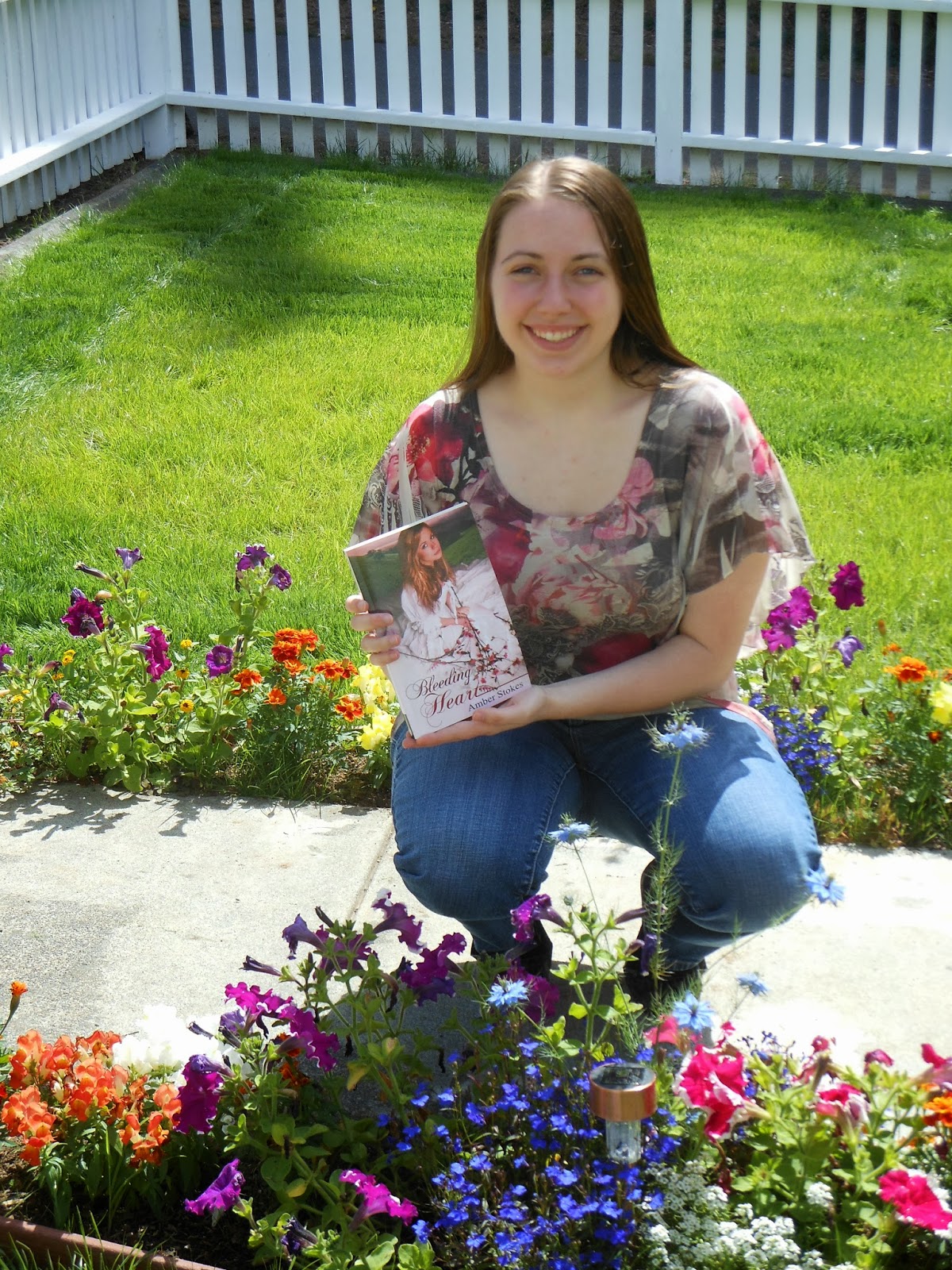
This week's puzzle feature is brought to you by Amber Stokes and her newest release, Bleeding Heart.

Thursday, November 7, 2013


Amber here! I was excited when, a while back, my fellow BB’ers agreed to spotlight me and my debut, Bleeding Heart, this week. Unfortunately, a combination of my procrastination and some really hard things in my life right now led to a recycled guest post and a last-minute Q&A (hence the reason I’m posting this instead of Yvonne). I just wanted to give you a heads up on that – and to thank the rest of the BB team for being so patient with me and still helping me to share my book with you! I’m honored by this chance to introduce myself to our readers and to share some of my thoughts on the life of a writer.

Do you write full time, or do you work it in alongside a full-time job?

Ummm… I wouldn’t say I write full time, but neither do I have a full-time job, per se. I’m in an interesting season of my life. I graduated with my bachelor’s degree from Corban University about a year and a half ago, and since then I’ve started a freelance editing & publicity business (Editing Through the Seasons), which I’ve been cultivating in addition to pursuing self-publishing and blogging here and at Seasons of Humility. So, I guess you could say that right now the book business, in general, is my full-time job. (There’s not a whole lot of money in it at this point, but I’m blessed by this opportunity to pursue my dreams while being with my family.)

Do you write every day? What does your typical writing day look like?

So far in my writing career…that would be a “no.” Well, at least as far as working on my novels! But I suppose I do write something pretty much every day, even if it’s just e-mails or blog posts. (That should count, right?)

My novel writing, though, has been rather sporadic. It took me years to complete the first draft of Forget Me Not, and it took me a couple of years to complete the first draft of Bleeding Heart. (As I’m getting ready to do rewrites/edits for Forget Me Not, I’m hoping I can be a little quicker with this stage, LOL!) I kind of go through seasons where I focus on the novel writing, though, and then it can be between a few hundred and maybe a thousand or more words a day. I don’t generally write a whole lot at a time – usually just a scene or two. It feels good, though, to celebrate the small accomplishments, and having accountability (either by having someone read as I go along, like my dear friend Amanda Stanley did for Forget Me Not, or by doing #1K1Hr “competitions” with writer buddies on Twitter) certainly helps! I’m hoping that I can now take more time to focus since I’ve published my debut and have launched my writing career. Since I’m self-published, I don’t have deadlines imposed on me by a publishing house, but there is the pressure of getting more books out there to my readers in a timely fashion!

Have you ever had a funny experience connected with being an author? For instance, has someone ever overheard you discussing the merits of one murder weapon over another or caught you shooting at a can of gasoline to see if you could make it explode?

Well, I’ve had some interesting talks with Gary Teel of TNT Stagelines… I remember asking some silly questions when I was working on the first draft of Forget Me Not (releasing Winter 2014) and an essay on Virginia City, such as, “How long were stagecoaches around?” To which he answered something to the effect of “I’m still using one!” LOL.

Also, my excitement over the “Sin in the Sagebrush” exhibit at the High Desert Museum a few years back might have come across as a little strange. I doubt there were many others taking notes about gambling and prostitution back in the day. *wink*

Are you a plotter, a pantser, or a combination?

I suppose I’m sort of a combination… You can call me a pantser-plotter, heavy on the pantser! I do like to have a general idea of the theme and the basic storyline before I start or as I’m starting, as well as the title. I might write down a few ideas or daydream about/ponder the story. But really, I’m pretty much a pantser (i.e.: writing by the seat of my pants). A lot of the details and scenes come as I’m writing. For Bleeding Heart, I had the title and some characters already in place as I started writing. I think my desire to explore different definitions of love came early on in the writing stages. But I believe even I was unsure for a while who my heroine was going to end up with and where things would go after I reached and passed the big plot twist. Really, so much of it comes together over time, as the story unfolds in its seasons.

How do you get your best ideas?

I like to think my writing is atmospheric (I hope readers would agree!), and I’m inspired by the places I’ve been – the beauty of nature, the history of a town, that hint of mystery and enchantment in the air. And the little things – like the name of a flower, verses from the Bible, an emotion or glimmer of a theme I want to explore – can easily send me off on a writing journey.

What’s your favorite method for keeping a story’s middle from sagging?

The thing is, my stories aren’t very long. My short stories are generally quite short, and my novels are at the lower end of novel word-count range. I guess you could say I’m short-winded…but I like to think that I write what needs to be said and leave it at that. *wink*

All that to say, at this point in my writing career, I don’t like to add word count just for the sake of adding word count, as long as I’m at a decent number. I don’t want any scene to be sagging – or distracting from the message and direction of the story as a whole. And I guess part of that is that I only write the scenes that I’m interested in writing, you know?

So one way to keep the middle from sagging is to have each scene be important. Each scene moves the story and characters along, and so the journey continues from page one until the last word. I’m sort of in love with the “journey” idea really – and so far I’ve incorporated that in my historical romances by taking the characters on physical journeys that emphasize the emotional journeys. I love making my characters travel, and I think the exploratory elements make a story exciting throughout.

And here’s a quote from Dr. Seuss I found on Pinterest that goes along with my philosophy:


Amber Stokes has a Bachelor of Science degree in English and a passion for the written word - from blogging to writing poetry, short stories, and novels. After her brief time at college in Oregon, she is now back home among the redwoods of Northern California, living life one day at a time and pursuing her passion via freelance editing and self-publishing.

You can connect with Amber on her personal blog (Seasons of Humility), Twitter, Pinterest, Goodreads, Shelfari, and LinkedIn. You can also learn more about her books at www.bleedingheartnovel.blogspot.com and www.forgetmenotnovel.blogspot.com


Don't forget to stop by tomorrow to enter to win a free Kindle copy of Amber’s debut, Bleeding Heart!

Newsletter Subscribe

Followers

Categories

Blog Archive

Powered by Blogger.

Historical Romantic Suspense

Historical Romance

Comments

Comments

Popular Posts

Guest Registry