Showing posts with label Sylvia Bambola. Show all posts

Thursday, May 14, 2015


Heritage Publishing, 2015

BB: Hello, Sylvia! Welcome to The Borrowed Book. Do you ever read your dialogue aloud to see how it sounds? And have you ever performed an action you want one of your characters to carry out in order to help you visualize or describe it?

Bambola: I actually read the entire manuscript out loud. It’s amazing how those awkward words or phrases will jump off the page! And yes, especially the dialogue. Hearing it lets me know, in short order, if it’s stilted, awkward, fake, or doesn’t resonate with my particular character. I rarely perform the actions of my characters. But what I do is visualize each scene as though I’m watching a movie. I literally see it in my mind’s eye, how my characters move, their facial expressions, their emotions. If it all seems realistic and possible, then I go ahead and put this vision to paper. If not, I rework the scene in my mind.

BB: What aspect of being a writer is the most challenging for you? What steps have you taken to overcome this hurdle?

Bambola: Hands down, the most difficult aspect of being a writer is the marketing—a problem since marketing is a big part of a writer’s life. It’s absolutely necessary if we want to sell books. And traditional publishers expect this from their authors. Only problem, most writers want to write not participate in the business end of things. So what to do?  For me, overcoming this problem meant I had to get over myself and realize that both writing and marketing are “all as unto the Lord.”

BB: If you felt the Holy Spirit urging you to quit writing, would you do it?

Bambola: Without a doubt, “yes.” For me, writing is a ministry and would have very little meaning if God were not in it.

BB: If you’re a plotter, have you ever tried pantsing it? If you’re a pantser, have you ever given plotting a try?

Bambola: I’m definitely a pantser but I have tried plotting as well and found it too restricting. I want to be surprised by the story line and by my characters, and for me pantsing works best. That’s not to say I don’t have some idea where the story is going, because I do, especially when writing historical fiction since research of the times and events will dictate where you go. My recent novel, The Salt Covenants, takes place in 1493 Spain when the Inquisition is in full swing. What would happen if a young Jewess, who had converted to Christianity, suddenly came under the scrutiny of an inquisitor? Would she flee? Would she go to a new land with someone like Christopher Columbus, and could she reasonably go by herself or would she have to be accompanied by a man? And if yes, would that man be a husband? A brother? A father? The answer to these questions, and others, restricted where I could go in my novel. But even when writing historicals I’m a paster and generally am surprised by some of my plot twists. And I hope my readers are too. 

BB: Does your best writing flow? Or are you most satisfied with the work that you’ve labored over, sweating and groaning?

Bambola: I’d love to say that inspiration carries the day, when words flow so beautifully and freely that my fingers can’t type them fast enough, but for me this doesn’t happen often. In reality, my writing feels more like pushing wet concrete hill, very labor intensive and often frustrating. So I’d have to say usually my best work comes only after hours of much labor and groaning and sometimes even sweating.

BB: Do you prefer writing the initial draft, or do you enjoy the revision process more? Do you revise as you write, or do you first produce a big mess that you later have to fix? If your first draft is rough, do you have to cut out a lot of dead wood, or add flesh to the bare bones?

Bambola: I don’t think there’s anything more intimidating to a writer than that dreaded blank page. The purpose of my first draft is to fill pages, get my characters from point A to point B, and make sure that where they are going and where the plot is going are rational and believable. Is it a big mess? Actually, it’s more like some nasty thing you’d scrape off your shoe. Usually I have very little dead wood to cut, just a lot of flesh to add. But that’s the process I really LOVE. For me it’s a joy to see my characters come alive, to begin breathing on their own and to see the plot actually develop in a way that carries the story smoothly from scene to scene. 

Author Bio:

Sylvia Bambola
Sylvia Bambola is the award winning authored of seven novels, has two grown children, teaches women’s Bible studies, and is learning the guitar. Born in Romania, Bambola lived her early years in Germany. At seven she relocated with her adopted family and saw the Statue of Liberty and America for the first time. But the memory of those years in post World War Germany inspired her to write Refiner’s Fire, which won a Silver Angel Award, and was a Christy Finalist. Publishers Weekly, in their starred review, called Bambola’s latest novel, The Salt Covenants, “transcendent” and “beautifully written” while Library Journal says it “adeptly depicts a time and place not often explored in Christian historical fiction.”


To Buy:
Barnes and Noble:  http://www.barnesandnoble.com/1120995842?ean=9780989970778

Links:

Tuesday, May 12, 2015


My grace is sufficient for you.”
Heritage Publishing, 2015

When that scripture raced through my mind I knew it was from the Lord. I had not been thinking about God’s word or even about God, for that matter, as I stood in the hospital confronting the reality that my beloved husband of nearly forty-four years was losing his battle with lung cancer.

My grace is sufficient for you.”

Again that thought filled my mind. But doubt filled it, too. Was God’s grace really going to be sufficient in the coming days, months and years as I struggled to carve out a life without my beloved Vincent? My husband and best friend? You can’t live with someone for over forty years without becoming “one.” Time has a way of balancing out the differences. The best of our individual personalities complimented the other, the worst became grounds out of which patience, understanding, and kindness were forged. But two becoming one meant a tearing apart when only one was left. And tearing hurts.

When the inevitable happened, there was a flurry of activity: funeral arrangements, memorials to put together, people coming and going, out of town visitors. The activity blunted the pain. But when it was all over the real business of healing and moving on, began.

My grace is sufficient for you.”

Family and friends can’t hold your hand forever. In the midnight hour, when alone, lonely, and floundering, I discovered there is God. And every time I reached out for Him, He never failed me. He’d pull me from the brink of that pit of self-pity, and kept me from sliding down a slippery slope from which it’s so difficult to escape. But here’s the deal: I had to make that decision each and every time; the decision whether to call upon God, whether to remind myself that His grace is indeed sufficient, or whether I would indulge my feelings. And when I chose “grace” it was miraculous. I’d find myself praising God, find myself really believing that my life wasn’t over, that He still had a plan and purpose for me. And doing this wasn’t a denial of my feelings, rather it was an admission that God did all things well, that His ways were higher than mine, and that I could trust Him.

I’d like to say this was easy. That reminding myself of the scripture God gave me made all the hurt and difficulties go away. It did not. Often this was a moment by moment decision. But as time when on, it became less so. My husband has been with the Lord for nearly four and half years now and still I’m finding God’s grace sufficient. It’s there for me whenever I enter an arena with all couples and I’m conspicuously a solo, when family birthdays come up, during our wedding anniversary date, etc., and throughout it all God continues to pull me into a joyful present and a promising future.

But aside from understanding that God’s grace is sufficient, I’ve learned that every loss can be a testimony to God’s grace in our life. And since we all have or will experience some kind of loss during our earthly journey, we can rejoice in this truth. God is wonderful and cares so deeply for each of us. So when hurtful difficulties arise, and they will, remember God’s promise:

“My grace is sufficient for you.”


Author Bio:

Sylvia Bambola
Born in Romania, Sylvia Bambola lived her early years in Germany. At seven she relocated with her adopted family and saw the Statue of Liberty and America for the first time. But the memory of those years in post World War Germany inspired her to write Refiner’s Fire, which won a Silver Angel Award, and was a Christy Finalist. Publishers Weekly, in their starred review, called Bambola’s latest novel, The Salt Covenants, “transcendent” and “beautifully written” while Library Journal says it “adeptly depicts a time and place not often explored in Christian historical fiction.”

To Buy:

Monday, March 17, 2014

Today we're featuring author Sylvia Bambola, who's sharing about writing what you love vs. writing what you know. Read on to learn her thoughts on the subject, and to learn about her latest release!

Writing What You LOVE

Mark Twain said “Write what you know.” And the words of a luminary like Twain are generally held in high esteem. I mean, practically every school in America has at least some of his works in their library. Others even make reading them mandatory. So when I find myself contradicting a known master like Twain, I know I do so at my own peril. But the truth is if I had followed his advice I never would have written a single word.

From a young age I loved reading and telling stories. My friends and I would sit around for hours making them up. And always my stories were about things that excited me or things I cared deeply about. So my rule as a writer has always been “write what interests you.” In other words: write what you love. If I’m not interested in the subject; if I’m not passionate about it, I doubt I’d be capable of interesting anyone else. To my mind, events, customs, history, all these things can be researched. And yes, that takes hard work. But it enables me to write the kind of stories I want. The other difficult challenge, of course, is to populate these stories with characters who are believable and who touch hearts.

My first novel, A Vessel of Honor, written under the pen name of Margaret Miller and published well before 9/11, was about terrorism. The rise of radical Islam concerned me greatly. How would it affect America should it reach our shores? How would it affect my family? And others? Would the issue of faith make a difference? To answer some of these questions, I decided to build my story around two women: one a Christian, the other not, so I could explore how their faith or lack of it would impact them in such a crisis. The book ended up winning a Small Press Editor’s Choice Award and being seriously considered for a television movie.

My next novel, Refiner’s Fire, was about the underground Church in Romania during the brutal reign of Nicolae Ceausescu. This subject interested me deeply because I was born in Romania but later adopted by an American family. It really caused the “what ifs” to swirl around in my head. What if I still lived in Romania? What if I had to endure such persecution? What would it be like? And how did the Christians stand up under it? To explore this I decided to use two brothers separated after World War II then coming together again as men: one, the US Ambassador to Romania; the other, a Romanian Colonel. It became a Christy Finalist and won a Silver Angel Award.

I now have six published novels, and each of them was birthed out of passion and interest. Knowledge came later. Many writers write wonderful books by “writing what they know.” I’ve even heard of some who can pump out thousands of words a day with seemingly little effort. But I’m not blessed that way. It takes me a long time to write a book, so I need to invest that time in subjects that matter to me so I can bring the things I care about to my readers, and hopefully make them care about them too.

 But in the end, every writer must find his own way—the thing that makes him want to get up in the morning and face another blank page. And what’s so exciting is this: God can use us all.

Sylvia Bambola is the award winning author of six novels, including Refiner’s Fire and Tears in a Bottle. A resident of Florida, she teaches women’s Bible studies, has been a guest speaker at Women’s Aglow and various church functions, has two grown children, and is currently learning the guitar. 

You can connect with Sylvia on her website, Facebook, Twitter, and/or Goodreads.

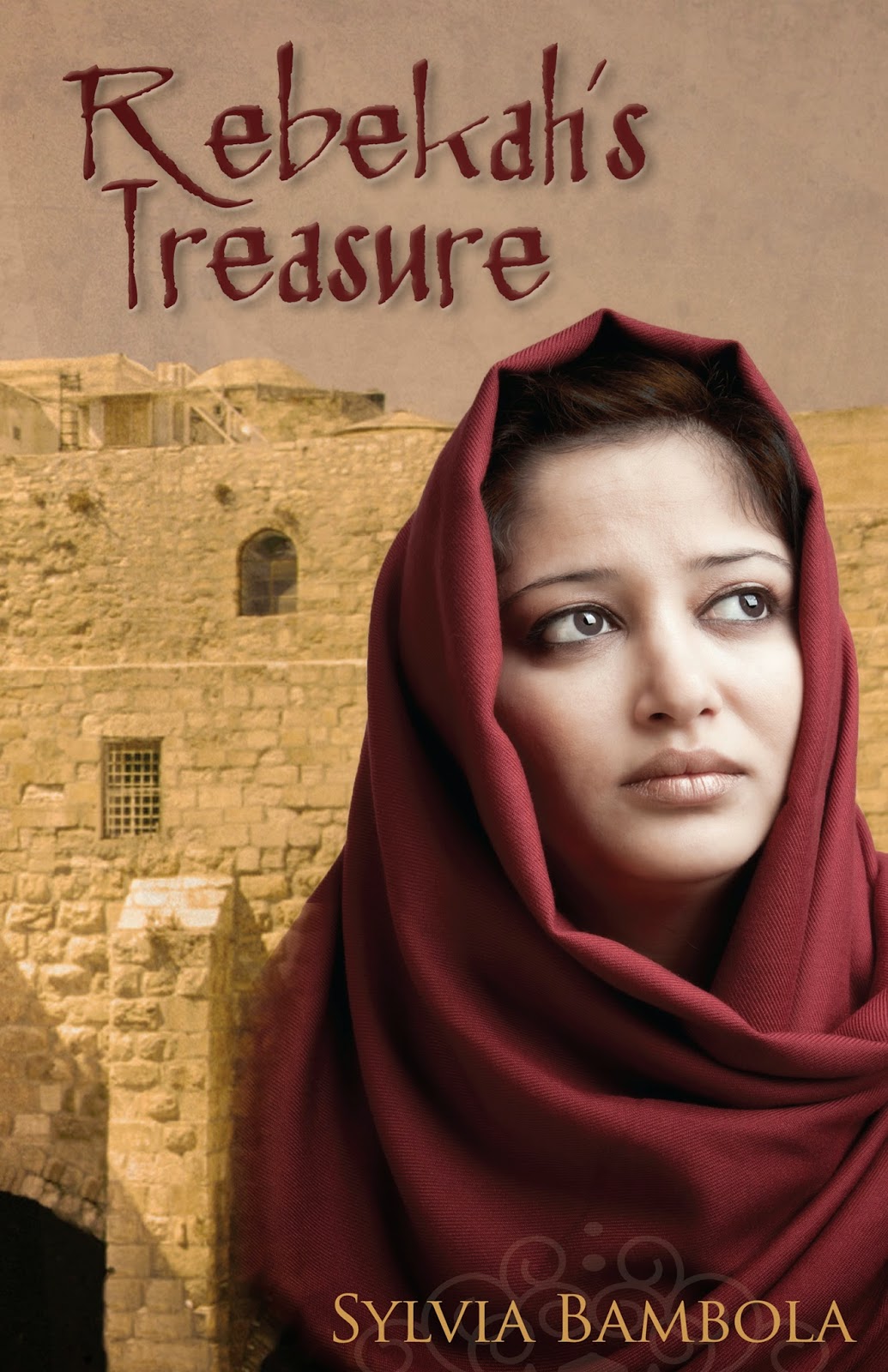
And you can purchase Sylvia's latest release, Rebekah's Treasure (released January 2014) now on Amazon! Here's some more info about the book:

FIRST PLACE WINNER FOR ADULT FICTION IN THE FLORIDA STATE ASSOCIATION NATIONAL LEAGUE OF AMERICAN PEN WOMEN

Forced to flee war-torn Jerusalem in 70 A.D., Rebekah and her husband, Ethan, each take something of value: Rebekah, the cup of the Last Supper; Ethan, a copper scroll detailing the whereabouts of a vast Temple treasure. Ahead, separation and danger face them as each tries to survive. But it’s not only external forces that could keep them apart forever but internal ones as they struggle to discover where their true treasure lies.

Newsletter Subscribe

Followers

Categories

Blog Archive

Powered by Blogger.

Historical Romantic Suspense

Historical Romance

Comments

Comments

Popular Posts

Guest Registry