Thursday, April 9, 2015


After a successful career in mathematics and computer science, receiving grants from the National Science Foundation and NASA, and being listed in Who’s Who in Computer Science and Two Thousand Notable Americans, James R. Callan turned to his first love—writing.  He wrote a monthly column for a national magazine for two years. He has had four non-fiction books published.  He now concentrates on his favorite genre, mystery/suspense, with his sixth book releasing in 2014.

Learn more on his Blog and also his Amazon Author Page

Over My Dead Body is now available for pre-orders.   


The challenges in writing are many.  Everyone who sits down and faces that blank sheet of paper knows that.  What do I put on it?  What can I say that anyone will care to read? How will I get anyone to buy this even if I can write it? Self-doubt is a constant companion of the writer.

For me, I find two major obstacles in the writing life.  The first is time.  Writing a novel is a long process.  Because I like to see results quickly, I find I am drawn to chores that can be finished much faster.  Here is a decision to be made: do this short task, perhaps a household chore that can be completed in a few hours, or work on a novel that won’t be finished for eight months? 

The answer seems simple.  Do the household chore, finish it in a few hours, and work on the writing tomorrow.  What is a one day delay in an eight month project?  Finish the chore, get that feeling of accomplishment and get back to the novel.

The problem is that tomorrow there will be another chore that only requires a day. It could be finished, I get that sense of accomplishment, and the eight month project is only delayed two days.  What are two days in an eight month project? 

You can see where this is going.  There is an endless string of “short” projects vying for attention. And each will only delay the novel by a day.  But the few days turn into a few weeks, and before you know it, the weeks have become months.  Before you realize it, the really important project, the book, is delayed a year.

Big problem for those of us who need that sense of accomplishment, of completing a job. 

Let’s assume for a moment that I have managed to avoid some of those “shorter” chores and have actually completed the book. Now comes the second major obstacle: marketing. 

Marketing comes with several problems. First, it is something many writers are not familiar with. Then there is the uncomfortable fact that most writers are not particularly good at it.  And most writers are not interested in becoming good at it. 

Edie Melson, author, and editor, says with careful planning, you can achieve a good, solid social media presence in just thirty minutes a day.  Sound doable.  But I have not managed to do it right.  I can limit my time to thirty minutes a day, but I haven’t managed to get the solid media presence.  So I find the social media time growing and the results not growing.

Obviously I have not mastered this important challenge for the writer.

At this point, I’m batting 0 for 2. 

I am often asked if I am a plotter or a pantser. 

I think I am both.

I do a certain amount of plotting before I begin.   I like to have a direction, an obstacle, and a possible solution.  I don’t need all the details. I probably don’t know the subplots.  But I need the obstacle.  And before I actually begin, I probably have a number of snippets of conversation written.

Now, I’m ready to begin. The characters will help dictate any changes in the direction.  I am perfectly willing to let them do this.  I have tried to get to know my three main characters (protagonist, sidekick, and antagonist) before I begin.  I have visited with them, listened to them, and gained a lot of background information on each of them. If they begin to talk to me, to make suggestions, I am certainly going to listen, and quite likely follow their suggestions.

In this respect, I am a pantser.  The end result is that I employ both methods in the course of writing a book.

In Over My Dead Body, I began with the simple idea of a man dead while in the midst of a dispute with a large corporation over its exercise of eminent domain.  I set up my main characters.  I knew two of them well.  I had several snippets of conversation. I have a dialog signature for each. Generally, if I can hear the characters speak, I’m a long way toward really knowing them. I was ready to begin. And the pantser mode takes over.


Perhaps I am best described as a hybrid writer, ready to tackle those two big obstacles I face in writing.
Tuesday, April 7, 2015

One of the greatest challenges in life is raising kids.  You walk the fine line between trying to make everything right for them and letting them find their own way.  When they are young, you want to protect them from everything.  Yet, you want them to learn how to take care of themselves.

While I was at the University of Oklahoma, our two older children started to school.  By their second year, they were walking to school by themselves.  It was only a few blocks in a nice university town.  They liked the independence and we fretted.  But it got easier on us as the months went on.

One day, shortly after they left and I was about to leave for campus, the phone rang.    I was giving a seminar on information value theory. Probably a student asking about an assignment.  I answered the call.

“They have taken your son to the hospital. We do not know the extent of the injuries.  Your daughter is not hurt.”

Crushing news first stops all rational thought and makes you unable to move. Then you are propelled into a frenzy of activity.  Minutes later we enter the hospital at full speed, only to be brought to a standstill by the steady, slow pace of the admitting personnel.  Eventually we are allowed to talk to the doctors.  They are calm, grave, reserved. It isn’t their child. Our son has suffered a severe concussion but they believe it is “not serious.”   To us, severe and not serious don’t seem to go together. They will keep him in the hospital for a day or two for observation.  For us, that seems to eliminate the “not serious” part of the description.

We are allowed to see our son. He is sleeping. I think.  Or maybe he’s in a coma. I can’t tell.  I choose to believe he is sleeping.

I stay the night in an uncomfortable chair.  He sleeps.  I do not.

But early in the morning, he wakes up.  He doesn’t know where he is and I tell him he in the hospital. 

“Why am I in the hospital?”

I explain that a car hit him.  “The driver was turning and the morning sun blinded him and he didn’t see you.”

He is satisfied with that and seems to ease back into sleep. 

An hour later, he wakes and asks, “Why am I in the hospital?”

I explain about the accident and he nods.

For the next twenty-four hours, this same scene is played out a half-dozen times.  Each time, I am getting more concerned.

On the third day, the doctors tell me we might as well take him home.  He needs rest and he can get that at home as well as in the hospital.  I ask about his continual questions about why he is in the hospital. They are unconcerned.  Short term memory, they assure me, will return.  When? I ask.  When it returns, they answer.

At home, he eats very little - small amounts of Jello, a little milk, little else.  This is from a boy who is generally a big eater.  After his second day at home, I finally get to campus and give the seminar that had been scheduled five days earlier.  It is not a great presentation.

That night, I am sitting in the living room and in walks my son.  It is the first time he had been up without being coaxed out of bed.  “I’m hungry,” he says.  I get a small bowl of pudding and bring it in.  “No. I’m really hungry.  Can I have a hamburger and some potato chips?”

Wow. I am eager to fix him a meal.  After he finished, he asks for his books.  “I need to do my homework. I’m going to school tomorrow.” 

He is fine. And a few days later, so am I.

That was in my days as a mathematician. Now that son is a college professor and I write mystery and suspense books.  The second in my Father Frank mysteries, Over My Dead Body, will be out in May. The first, Cleansed by Fire, is available as a paperback, a Kindle edition, an e-pub, and an audio book, narrated by five-time Emmy Award Winner Jonathan Mumm.  You can find more at:  http://amzn.to/1fqgWee.


After a successful career in mathematics and computer science, receiving grants from the National Science Foundation and NASA, and being listed in Who’s Who in Computer Science and Two Thousand Notable Americans, James R. Callan turned to his first love—writing.  He wrote a monthly column for a national magazine for two years. He has had four non-fiction books published.  He now concentrates on his favorite genre, mystery/suspense, with his sixth book releasing in 2014.

Amazon Author Page:    http://amzn.to/1eeykvG

His new release, Over My Dead Body, is available for pre-orders at:   http://amzn.to/1BmYQ0Q


Monday, April 6, 2015

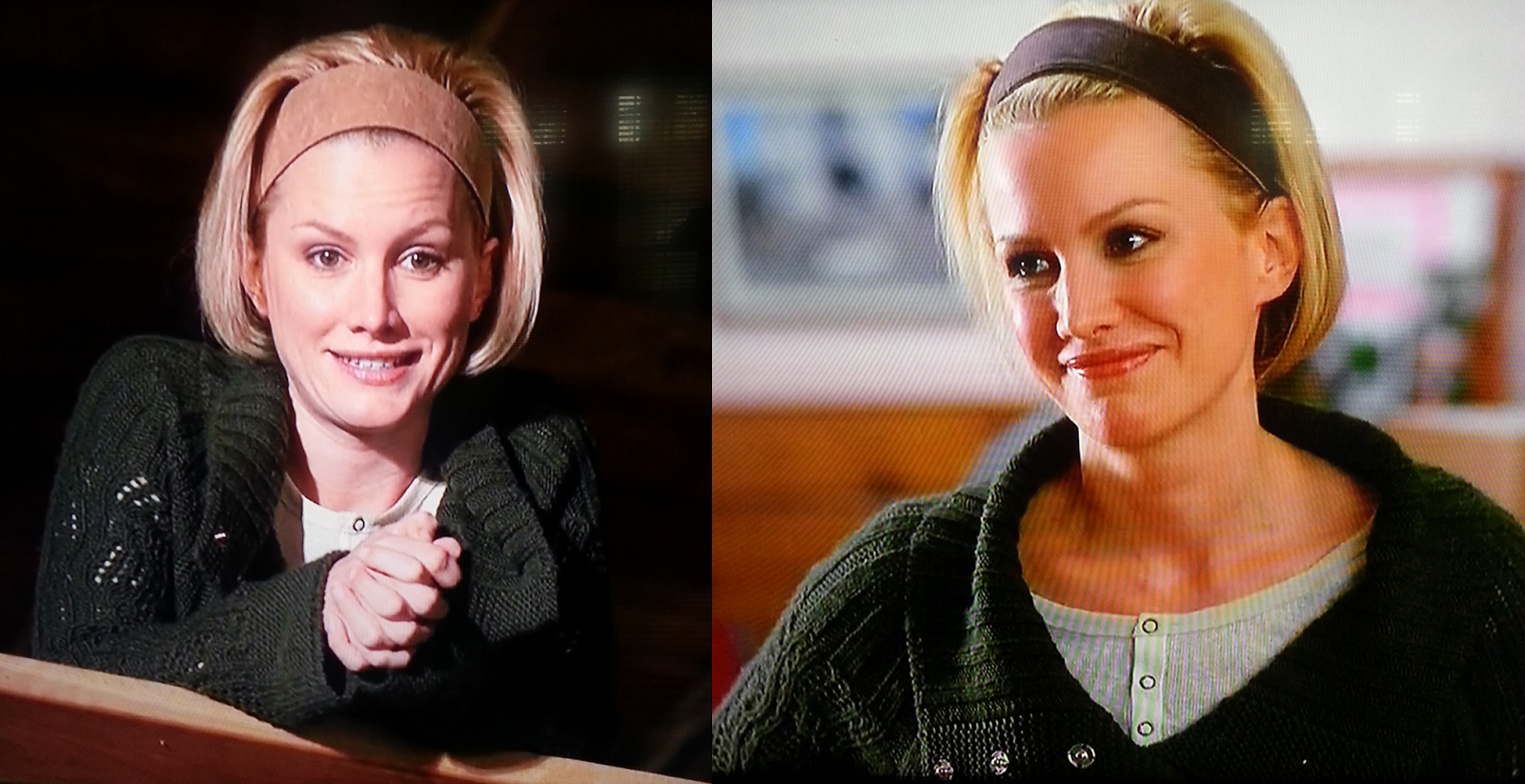
I was watching a Christmas movie the other day—something I enjoy no what the time of year. This was one of my favorites, so of course, I had seen it before, many times. Suddenly, I saw something I’d never noticed before: 

Do you see it? I’ll wait while you look again. 

Yep, there it is. The actress’s headband goes from beige in the first scene, to brown in the next. And several scenes later, she’s back to beige: 

Mistakes like this happen all the time. Despite rounds of edits, and many pairs of eyes, stuff slips through. Sometimes, it’s only after reviewing something over and over that the flaws even become visible. 

Over the years, I’ve learned that people are like that. I’m like that. I make the same mistakes over and over, and am disappointed when the results are no different than the first time I tried. 

Maybe the reason flaws are so hard to spot is because we are so enamored with the way something SHOULD be, and not the way it is. 

 But hold on…sometimes, the opposite is equally as true. We scrutinize our every blemish, failing, and fault. We beat ourselves up. We compare. We criticize. 

Where is the balance? 

As a writer, I receive a fair bit of criticism, some of it external, and some (too much actually) internal. And what the blip from this movie showed me is that none of us are perfect. We’re flawed, but still lovely. After all, did the mistake in this movie ruin my enjoyment of it? No. Was I disappointed? Was the outcome changed? No. In fact, the movie was no more…and no less…than it was before I noticed the mistake. 

Maybe all of us need to realize that we'll never be the ideal we long for in our imagining. We can strive to be better, and in fact, I believe we should! But finding the balance between what is good and lovely, and what is harmful and destructive, is equally as important. 

So today, I reached a decision. I am going to feel out the flaws inside of me. I’m going to examine them, analyze them, and admit to them. And then I’m going to strive to be better than I was yesterday. Not by beating myself up for my shortcomings. Instead, I’m going to learn to love myself for who I am now, and not who I hope to be. After all, who I am, is all I have. 

BTW…bonus points if you can tell me the name of the movie I snatched the scenes from above. 


Elizabeth Ludwig is the bestselling author of Christmas Comes to Bethlehem, Maine and the highly successful Edge of Freedom series from Bethany House Publishers. Her popular literary blog, The Borrowed Book, enjoys a wide readership. Elizabeth is an accomplished speaker and teacher, often attending conferences and seminars where she lectures on editing for fiction writers, crafting effective novel proposals, and conducting successful editor/agent interviews. Along with her husband and children, she makes her home in the great state of Texas. To learn more, visit ElizabethLudwig.com. 

Sunday, April 5, 2015

Speechlessness in the mouth of a preacher is not a good thing.

Speechless, however, is exactly how the followers of Jesus found themselves on the morning of that third day.

It’s also where I find myself now.

I’ve written for weeks on varying stages and aspects of Christ’s journey to the cross. And now, today, we celebrate the anniversary of the day He rose from the dead, and I am at a loss for what to say about it. It’s nice, as I look back, to know I’m not the only one.

I listen to my fellow believers reflect on this season with varying degrees of awe, thankfulness, and joy. All I can think about, however, as I go back and read over the accounts of the actual Resurrection, is how dumbstruck the core group of disciples was.

Why was this? Jesus had warned them often enough in the weeks beforehand that His death would take place. “And on the third day, I will be raised.”

In the shock of witnessing his death—which surely was more awful than they dreamed possible—did they not believe the last thing would come to pass?

The women believed, and bursting with joy, ran to share the news, although it’s clear that Mary Magdalene struggled at first with the  believing.

There were other hints that this particular plot twist was coming. The raising of Jairus’ daughter, the raising of the unnamed young man being carried away to his burial, the raising of Lazarus. Yet, it seems the disciples were tempted to believe the taunts above all else—“He who saved others is unable to save Himself.”

But—no. Oh no. He was more than able, just not in the way they expected.

I wonder, too, what the eventual state of belief was for those hapless guards left to keep watch over the tomb. They saw the angels. They knew the disciples hadn’t come and stolen the body. They were there to prevent that very thing, and yet afterwards they were paid off—by the Pharisees and chief priests, no less, not even Pilate himself—to say that very thing happened, after all. The irony!

When I reflect on the Resurrection of Jesus itself, words like glorious and awesome come to mind ... but we all say that, in our time. What about how it appeared to His original followers, and to those guards?

Stunning.

Terrifying.

Unbelievable.

Even now, people struggle to believe. Is it any wonder the rest of the world shakes its head at us, these crazy Christians who insist that there really was a literal resurrection?

And yet, on this hangs all of our faith. Not the value of Jesus as a good teacher, but as the Son of God and the Son of Man, perfect humanity offered up to die on our behalf, then risen again to life. The One who cracked death wide open, as the tomb was opened during that earthquake long ago.

May I walk today—and the rest of my days—living out the conviction that my lips speak. And may I ever be speechless before Him—but not in giving others an answer for what I believe.


1 Who has believed our report?
And to whom has the arm of the LORD been revealed?

3 He is despised and rejected by men,
A Man of sorrows and acquainted with grief.
And we hid, as it were, our faces from Him;
He was despised, and we did not esteem Him.

10 Yet it pleased the Lord to bruise Him;
He has put Him to grief.
When You make His soul an offering for sin,
He shall see His seed, He shall prolong His days,
And the pleasure of the Lord shall prosper in His hand.
11 He shall see the labor of His soul, and be satisfied.
By His knowledge My righteous Servant shall justify many,
For He shall bear their iniquities.
12 Therefore I will divide Him a portion with the great,
And He shall divide the spoil with the strong,
Because He poured out His soul unto death,
And He was numbered with the transgressors,
And He bore the sin of many,
And made intercession for the transgressors. (Isaiah 53)

1 Now after the Sabbath, as the first day of the week began to dawn, Mary Magdalene and the other Mary came to see the tomb. 2 And behold, there was a great earthquake; for an angel of the Lord descended from heaven, and came and rolled back the stone from the door, and sat on it. 3 His countenance was like lightning, and his clothing as white as snow. 4 And the guards shook for fear of him, and became like dead men.

5 But the angel answered and said to the women, “Do not be afraid, for I know that you seek Jesus who was crucified. 6 He is not here; for He is risen, as He said. (Matthew 28, all NKJV)

This post first appeared 4/20/14.

Thursday, April 2, 2015

When working on a manuscript, what do you do when you get stuck?


I’m a verbal processor, so talking out my ideas works best. God granted me the most wonderful gift—a husband who is a reader and who has wonderful plot advice, as well as several excellent friends who are willing to let me chatter at them. Typically, if my husband is home, I can brainstorm some ideas with him, and I’m quickly back to writing. If he’s not available, I contact one of my friends.


Do you ever read your dialog aloud to see how it sounds?

I often read my writing aloud. It’s helpful to see how things flow. If I get tongue-tied in trying to speak what I’ve written, there’s often a problem that needs to be tweaked.


Have you ever performed an action you want one of your characters to carry out in order to help you visualize or describe it?

Again, I often choreograph my writing by acting things out. I like to write westerns with lots of action scenes, so I often get up and try to act things out. My husband comes in handy with this also, since he teaches me some of the self-defense moves he’s had to learn for his job in law enforcement.


Have you ever embarrassed yourself doing this?

Well, sort of. Fifteen years ago, I rolled out of bed one morning with ideas flowing for my next scene. I set my toddler son down to watch cartoons and got busy writing. It wasn’t long before I stood up, put on my cowboy hat, and started acting out a scene. It was then I realized that my border collie wasn’t right under foot. UH OH! I yanked the front door open to see my mostly-white dog smeared black with mud from digging out under the back yard fence. He trotted down the sidewalk like he owned it. I put my son in his crib and raced out to chase my dog. We got to the end of the street, right in front of a house that had just sold. Of course, I hadn’t met the new neighbors yet. I reached for the dog’s collar when up goes the neighbors’ garage door. My dog raced into the garage…and right past the suit-clad neighbor into his house. I was forced to blurt out a hasty introduction and apology. Of course, I was a mess to behold. Bed head. Cowboy hat. Threadbare pajamas. Bare feet. Not the best way to meet your neighbors!


What aspect of being a writer is the most challenging for you? Why is this difficult, and what steps have you taken to overcome this hurdle?

For me, the hard part isn’t writing or editing. It’s having the patience to keep going in the face of rejection, disappointments, and endless waiting. To overcome, I ask God to help me hang on. I look for others whom I can encourage. I keep writing. And I try really hard not to think too much about it.


If you felt the Holy Spirit urging you to quit writing, would you do it?

I have already given up writing once. God called me to teach school for a period of three years. I’m not trained as a teacher, and never wanted to teach. But who am I to tell God no? So when he called me to that job, I did it. I was so busy for those three years that I had no time or inclination to write. Thankfully, He rewarded me by sending me home to write full time after that.


Do you prefer writing the initial draft, or do you enjoy the revision process more? Do you revise as you write, or do you first produce a big mess that you later have to fix? If your first draft is rough, do you usually have to cut out a lot of dead wood, or add flesh to the bare bones?

I prefer writing the initial draft to the revision phase. I tinker as I go, so I’m constantly tweaking wordings, fixing typos, and correcting plot problems. My biggest issue with my first draft is that I am far too wordy, so I have to do at least one pass to chop the word count down.


Award-winning author, Jennifer Uhlarik, discovered her love of writing as a pre-teen. She majored in writing at the University of Tampa and now lives outside of Tampa with her husband, teenaged son, and four fur children. Her first traditionally published work, Sioux Summer, is one of nine novellas included in The Oregon Trail Romance Collection, available from Amazon.   Her second work, Wedded to Honor, featured in The Convenient Bride Collection, is available for preorder now. Connect with Jennifer at www.facebook.com/JenniferUhlarikAuthor

Newsletter Subscribe

Followers

Categories

Blog Archive

Powered by Blogger.

Historical Romantic Suspense

Historical Romance

Comments

Comments

Popular Posts

Guest Registry